Kardameshwar • Kandawa
3 kos ≈ 9 km from the Gyanvapi/Manikarnika approach in the supplied route. Kardameshwar is associated with Sage Kardama and is the first major padav.
Open MapThe sacred 25-krośa circumambulation of Kashi — traditionally associated with a five-day pilgrimage, five principal night halts, and a sacred network of 108 shrines.
पञ्चक्रोशी परिक्रमा • Pañcakrośī Parikrama
its describes the Panchakroshi Parikrama as a traditional clockwise circuit around Kashi, approximately 25 kos and commonly completed over five days, with five major padavs (night halts). It also gives a route list of major shrines and ritual disciplines.
The traditional measure used for the sacred circuit. Modern descriptions commonly express the route as roughly 75–88 km, depending on the measurement tradition.
The traditional pilgrimage network is associated with 108 important shrines and sacred stations.
Kardameshwar, Bhimchandi, Rameshwar, Shivpur and Kapildhara are the five principal halting stations in the route .
The Kashi Khanda of the Skanda Purana has a dedicated Yatra Parikrama section. Its Chapter 100 index lists the pilgrimage system and includes Pañca-Tīrthikā, Vaiśveśvarī, Aṣṭāyatana, the 14-Linga pilgrimage, Ekādaśāyatanī, Gaurī, Gaṇeśa/Bhairava pilgrimages and Antargṛha Yātrā.
Modern Kashi heritage research connects the Panchakroshi sacred circuit with the Kashi Khanda's sacred geography, especially the Vinayaka network. The official Kashi government portal also describes the Panchakroshi Yatra as a roughly 25-krośa / 88-km circuit linking 108 shrines and identifies its roots in the Kashi Khanda of the Skanda Purana.
This traditional verse explains why the Panchakroshi Parikrama is understood not merely as a physical journey, but as a sacred pilgrimage of purification, discipline, devotion and surrender.
“अन्यक्षेत्रे कृतं पापं पुण्यक्षेत्रे विनश्यति।
पुण्यक्षेत्रे कृतं पापं वाराणस्यां विनश्यति॥
वाराणस्यां कृतं पापमन्तर्गेहे विनश्यति।
अन्तर्गेहे कृतं पापं वज्रलेपो भविष्यति॥
वज्रलेपच्छिदे ह्येतत्पञ्चक्रोशप्रदक्षिणम्॥”
1. A wrong action committed in an ordinary place is traditionally believed to be purified through sacred acts performed in a holy place.
2. A wrong action committed even in a holy place is traditionally believed to be purified in Varanasi (Kashi).
3. A wrong action committed in Varanasi is traditionally believed to be purified through the sacred inner pilgrimage of Kashi.
4. But a wrong action committed during that sacred inner pilgrimage is described as becoming extremely difficult to remove.
5. The Panchakroshi Parikrama is therefore presented as a sacred circumambulation associated with overcoming this deep spiritual burden.
Central message is simple: the Panchakroshi Yatra is traditionally understood as a journey of spiritual purification. The pilgrim travels around the sacred geography of Kashi, visits important temples and sacred places, follows traditional disciplines, and completes the journey with devotion.
The significance is not only the distance walked. The journey combines walking, darshan, prayer, self-control, sacred bathing or purification where appropriate, charity and remembrance of Shiva. In this traditional understanding, the physical circuit becomes a spiritual discipline.
The five-day route can therefore be understood on two levels: an outer journey around Kashi and an inner journey of repentance, devotion and transformation. Each padav and sacred station becomes part of that larger spiritual experience.
Panchakroshi Parikrama is traditionally understood as a sacred journey around Kashi in which the pilgrim combines physical circumambulation with devotion, discipline and spiritual purification.
The distances below preserve the approximate segment structure . “Kos” is retained as a traditional measure; kilometre conversions are approximate.
3 kos ≈ 9 km from the Gyanvapi/Manikarnika approach in the supplied route. Kardameshwar is associated with Sage Kardama and is the first major padav.
Open Map5 kos ≈ 15 km from Kardameshwar; cumulative ≈ 8 kos. The principal sacred focus is Bhimchandi Devi and the Gandharvasagar/Bhimchandi water tradition.
Open Map7 kos ≈ 21 km from Bhimchandi; cumulative ≈ 15 kos. Rameshwar and a group of Rama-lineage shrines including Bharateshwar, Lakshmaneshwar and Shatrughneshwar.
Open Map4 kos ≈ 12 km from Rameshwar; cumulative ≈ 19 kos. Panch Pandav temple and the five lingas associated with Yudhishthira, Bhima, Arjuna, Nakula and Sahadeva, together with Draupadi Kund and Draupadi Devi.
Open Map3 kos ≈ 9 km from Shivpur; cumulative ≈ 22 kos. The final 3 kos returns the pilgrim toward the sacred centre, completing the approximately 25-kos circle.
Open MapThe final return through the sacred route to Manikarnika and completion with concluding darshan at Kashi Vishwanath.
| Stage | Important shrines named in Yatra | Traditional focus |
|---|---|---|
| Opening / Central Kashi | Gyanvapi, Shri Vishwanath, Annapurna, Dhundhiraj Ganesha, Mod, Pramod, Sumukh, Durmukh, Gananatha, Dandapani, Manikarnikeshwar | Sankalpa, Vishwanath darshan and entry into the sacred circuit |
| Southern approach | Gangakeshav, Lalitadevi, Jarasandheshwar, Somnath, Dalbhyeshwar, Shulatankeshwar, Varaheshwar, Dashashwamedheshwar, Kedareshwar, Lolark, Arkavinayak | River, Shiva, Devi and Vinayaka sacred geography |
| Day 1 | Asisangameshwar, Durgakunda, Durgavinayak, Durgaji, Vishvakseneshwar, Kardamakunda, Kardameshwar | Kardameshwar padav |
| Day 2 | Nagnath, Chamundadevi, Moksheshwar, Karuneshwar, Unmatta-Bhairava, Vimala-Durga, Nandikeshwara, Jnanadeshwara, Mokshadeshwara, Amriteshwara, Bhimchandi Devi | Bhimchandi padav |
| Day 3 | Ekpada Gana, Mahabhima Gana, Bhairava, Bhairavi, Bhootnath, Sindhurodhas Tirtha, Kalnatheshwar, Kapardishwar, Kameshwar, Dehli Vinayak, Shodashavinayak, Uddandavinayak, Rameshwar | Rameshwar padav and Vinayaka/Bhairava network |
| Day 4 | Bharateshwar, Lakshmaneshwar, Shatrughneshwar, Panch Pandav, Draupadi Kund, Panchopacharesheshwar, Pramodeshwar, Tarneshwar, Nandikeshwar, Yajna Varaha | Shivpur / Pandava-Draupadi traditions |
| Day 5 / Return | Kapildhara Mahadev, Kapila Kund, Kapileshwar, Gaveshwar, Vrishabheshwar, Upashanteshwar, Bhojuva Bir, Jaun Ganesh, Varuna-Ganga Sangam, Manikarnika | Kapildhara, pitṛ rites and completion of the circle |
Avoid anger, false speech, gossip, hostility and deliberate harm; preserve the spiritual discipline of the yatra.
Its recommends satvik food, moderation, brahmacharya and disciplined thoughts, words and actions.
Walking is presented as the traditional form. Vehicle use is described as an accommodation for age or physical limitation.
At the appropriate sacred stations, pilgrims traditionally bathe or perform purification and then worship the designated shrines.
Charity to priests, needy persons and cows is included in the supplied rules according to one's capacity.
The uploaded text describes a final return to Manikarnika and concluding darshan of Kashi Vishwanath.
Practical note: Some detailed purity rules in the aded duploocument are traditional prescriptive statements, not modern municipal instructions. Visitors should follow current local sanitation, safety and temple regulations.
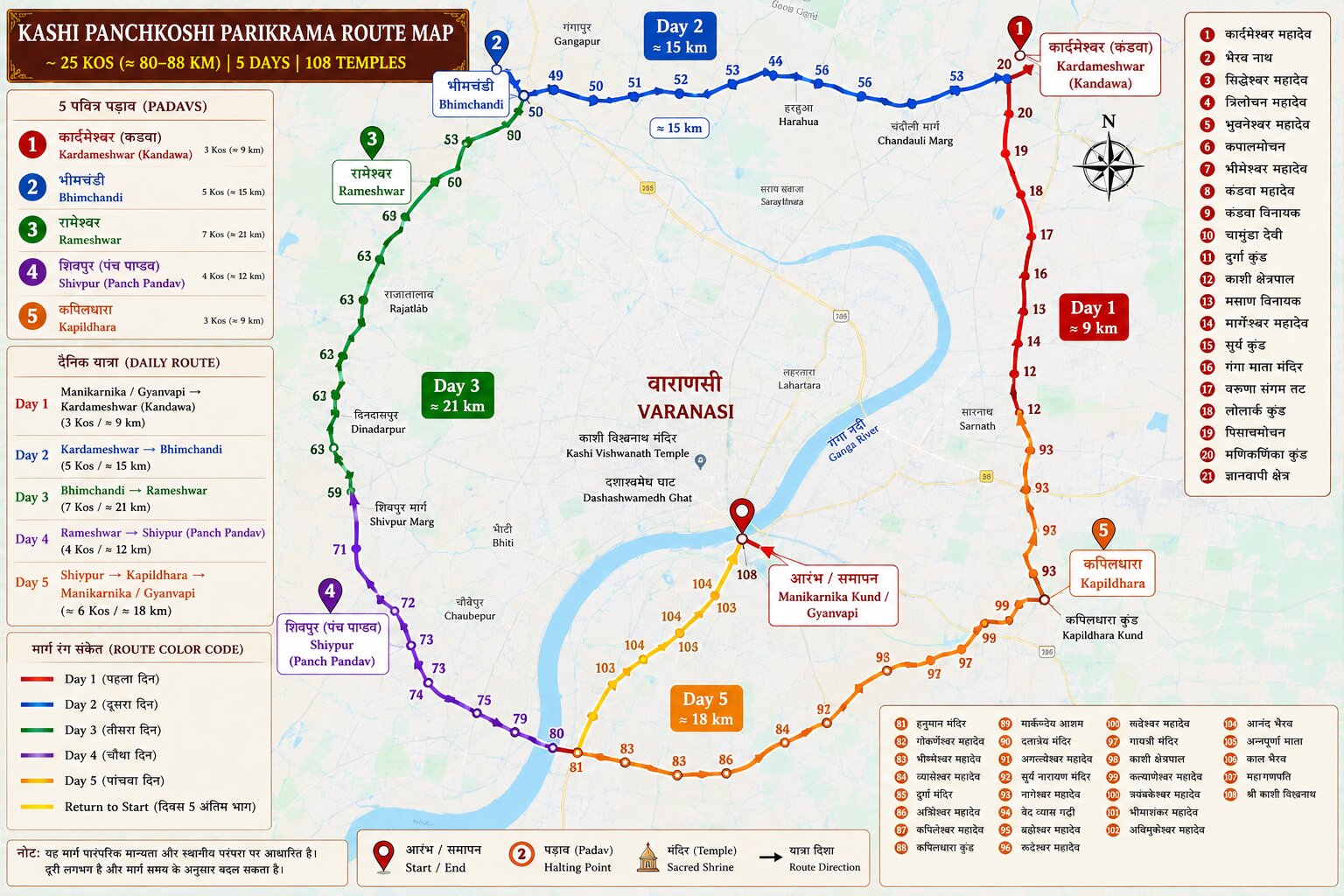
Route image: Kashi Panchakroshi Parikrama infographic supplied for this webpage. It presents the complete traditional circuit from the start/end point through all five padavs, using a different colour for each day's route and a yellow return-to-start segment.
Historical/route context: The official Kashi portal describes the Panchakroshi circuit as approximately 25 krośas / 88 km and associated with 108 shrines. Heritage research documents the five halt stations and the 108-shrine route.