ॐकारेश्वर
Body point: Śikhā / top-knot
Location: Omkareshvara, Pathanitola — A 33/23
The vertical crown/tuft represents the upward, transcendent axis of Shiva. The source tradition places Omkareshvara at the śikhā.
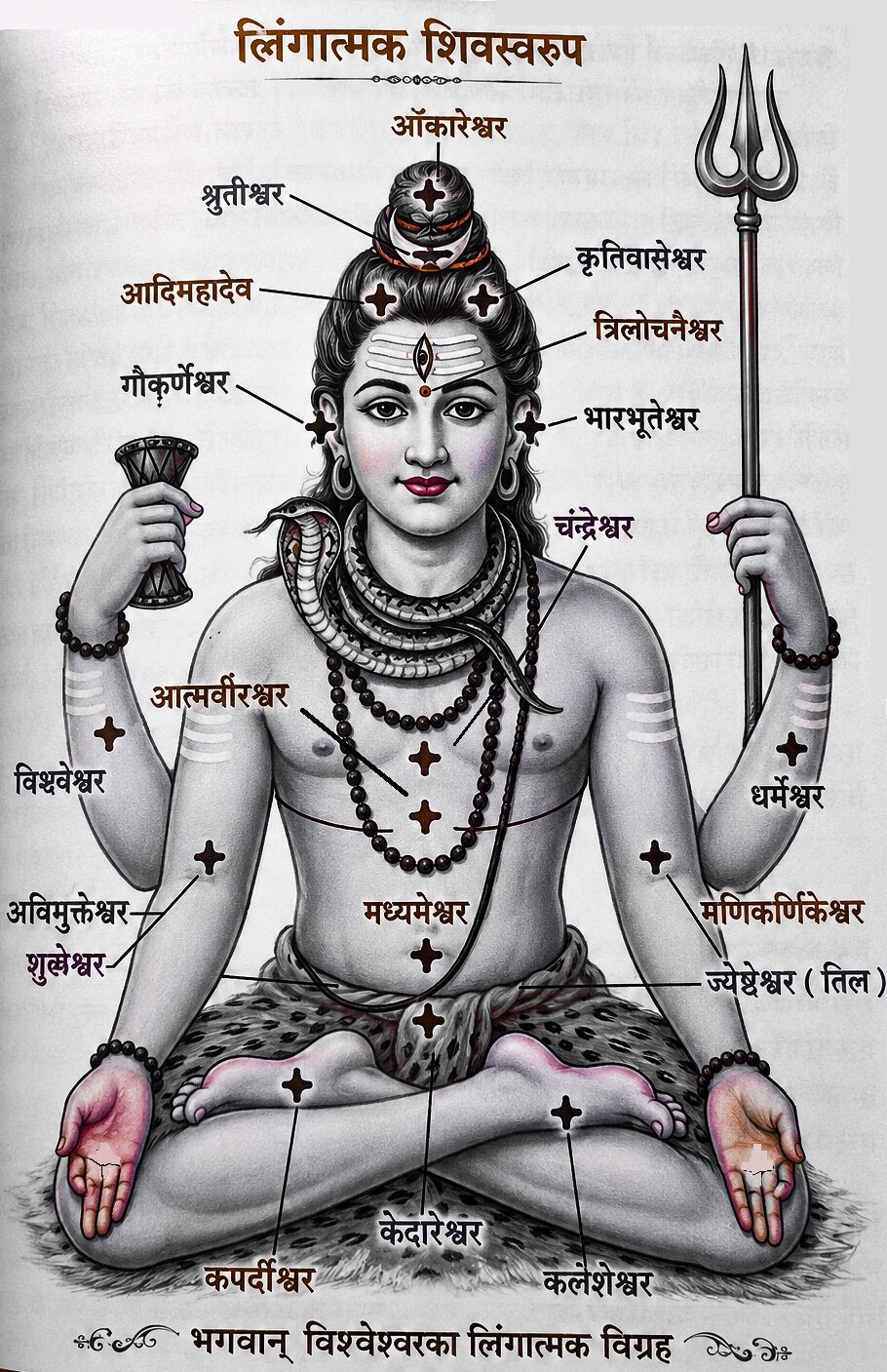
Vishveshvara's Lingātmaka Vigraha — the sacred idea that the geography of Kashi can be contemplated as the body of Shiva, with specific lingas representing the head, eyes, ears, arms, heart, navel, feet and generative principle.
This page brings together the Kashi Khanda 33.167–173 shlokas shown in the supplied book scan, their simple meanings, the supplied Vishveshvara body diagram, and a research-oriented list of traditional locations.

In the Kashi Khanda tradition, selected Shiva lingas are not merely separate temples. They form a symbolic anatomy: Kashi is contemplated through the body of Vishveshvara. A modern scholarly presentation by Rana P. B. Singh identifies 18 constituent Shiva lingas in this body-map and treats Krittivasheshvara as the total/head form that integrates the symbolism.
The following text is transcribed from the user-supplied scan. Sandhi and orthography have been kept close to the printed text; minor editions may differ in spelling or punctuation.
Simple meaning: Krittivasa is the crown/head-form of the whole symbolic body. Omkareshvara is the śikhā or top-knot, while Trilochana represents Shiva's three eyes.
The symbolism moves from the whole head to the upward tuft and then to divine sight.
Simple meaning: Gokarna and Bharabhuta are identified with the two ears. Hearing becomes part of the sacred geography: Kashi is a field in which sacred sound and revelation are received.
Simple meaning: Vishveshvara and Avimukta form the two right-arm positions; Dharmeshvara and Manikarnika form the two left-arm positions.
The body-map therefore places the central Vishveshvara shrine directly inside a wider symbolic anatomy.
Simple meaning: Kaleshvara and Karpardishvara represent the feet; Jyeshtha represents the waist/hips; Madhyameshvara represents the navel.
Simple meaning: Mahadeva and Shrutishvara are head ornaments; Chandreshvara is the heart; Vīreśvara is the ātmā — the inner self.
Simple meaning: Kedareshvara is identified with the linga, Shukreshvara with śukra (generative essence), while the innumerable other lingas are compared to nails, hair and ornaments of Shiva's body.
These cards separate the body-symbol from the present traditional location. This is important because some old sites have been lost, moved, re-established or represented by an associated shrine.
Body point: Śikhā / top-knot
Location: Omkareshvara, Pathanitola — A 33/23
The vertical crown/tuft represents the upward, transcendent axis of Shiva. The source tradition places Omkareshvara at the śikhā.
Body point: Śiro-bhūṣā / crest-jewel
Location: Road to Vriddhakala, near Ratneshvara — K 53/40
Shruti means sacred revelation. In this symbolic anatomy it is a head ornament, suggesting revealed knowledge crowning Shiva.
Body point: Śiro-bhūṣā / matted-hair ornament
Location: Adi Mahadeva, Trilochan — A 3/92
Mahadeva is shown in the head region. The local shrine is the Adi Mahadeva temple near Trilochan.
Body point: Locanāni / three eyes
Location: Trilochan Ghat, upper part — A 2/80
Trilochana literally means three-eyed. The linga represents Shiva's three eyes and therefore awakened vision and spiritual insight.
Body point: Dakṣiṇa-karṇa / right ear
Location: Rajadarwaja Lane, Gobindapura — CK 54/44
The right ear symbolizes hearing and reception. In the traditional body-map, Bharabhuteshvara is the right ear.
Body point: Vāma-karṇa / left ear
Location: Dayalu Gali, Kodai ki Chaki — D 50/34A
Gokarna is associated with the ear. Here it forms the left ear in the sacred anatomy of Kashi.
Body point: Dakṣiṇa-kara I
Location: Jnanavapi, Vishvanatha area — CK 35/19
This is the principal Vishveshvara/Vishvanatha Jyotirlinga of Kashi. In the body-form it occupies the first/right upper arm.
Body point: Dakṣiṇa-kara II
Location: Radhakrishna Dharmashala, Jnanavapi — CK 30/1; other traditional sites also recorded
Avimukta means 'never abandoned'. The traditional location record includes a site near Jnanavapi and other re-established/associated forms.
Body point: Dakṣiṇetara-kara I
Location: Mir Ghat, Dharmakup — D 2/21
Dharma is represented in the left upper arm: action guided by order, duty and sacred law.
Body point: Dakṣiṇetara-kara II
Location: Gomath Ashram, Brahmanal — CK 8/12
The Manikarnika form connects the left arm of the symbolic body with one of Kashi's most important sacred zones.
Body point: Caraṇa I
Location: Vriddhakala Temple area — K 52/39
Kāla means time. The foot symbolism places time at the foundation of the cosmic body: every embodied life moves within time.
Body point: Caraṇa II
Location: Pishachamochan — C 21/40
Kaparda refers to Shiva's matted hair/ascetic form. In the lingatmaka body-map this linga represents the left foot.
Body point: Nitamba
Location: Saptasagar, Kashipura — K 62/144
Jyeshtha means elder/foremost. The waist is the central supporting region of the body, linking upper and lower parts.
Body point: Nābhi
Location: Maidagin, Daranagar — K 53/63
Madhyama means middle. The navel is the central point of the body and therefore a natural symbol of Kashi's inner centre.
Body point: Ātmā
Location: Scindhia Ghat, near Sankatha — CK 7/158
The text calls Vīreśvara the ātmā, the inner self. The living local shrine is widely recorded as Ātmavīreśvara.
Body point: Hṛdaya
Location: Near Scindhia Ghat, Siddheshvari Temple — CK 7/124
The moon (Chandra) is placed at the heart: a symbol of mind, cooling grace, rhythm and inward devotion.
Body point: Liṅga
Location: Kedara Ghat — B 6/102
Kedareshvara is the linga itself in the symbolic anatomy. It links the physical symbol of Shiva with the generative and cosmic principle.
Body point: Śukra / bindu
Location: Kalika Gali — D 8/30
Śukra is the generative essence. In the verse it is paired with the linga, completing the reproductive symbolism.
House numbers and locality descriptions below are based primarily on Rana P. B. Singh's published Kashi divinity/location list, cross-checked with the supplied book scans. They are best treated as research landmarks, not as a guarantee that every shrine remains independently accessible today.
| No. | Linga | Body point | Symbol | Traditional location | Status | Interpretation / note |
|---|---|---|---|---|---|---|
| 01 | ॐकारेश्वर Omkareshvara |
Śikhā / top-knot | Hair tuft / śikhā | Omkareshvara, Pathanitola — A 33/23 | Present | The vertical crown/tuft represents the upward, transcendent axis of Shiva. The source tradition places Omkareshvara at the śikhā. |
| 02 | श्रुतीश्वर Shrutishvara |
Śiro-bhūṣā / crest-jewel | Crest ornament | Road to Vriddhakala, near Ratneshvara — K 53/40 | Present | Shruti means sacred revelation. In this symbolic anatomy it is a head ornament, suggesting revealed knowledge crowning Shiva. |
| 03 | आदिमहादेव Adi Mahadeva |
Śiro-bhūṣā / matted-hair ornament | Matted-hair/head ornament | Adi Mahadeva, Trilochan — A 3/92 | Present | Mahadeva is shown in the head region. The local shrine is the Adi Mahadeva temple near Trilochan. |
| 04 | त्रिलोचनेश्वर Trilochaneshvara |
Locanāni / three eyes | Three eyes | Trilochan Ghat, upper part — A 2/80 | Present | Trilochana literally means three-eyed. The linga represents Shiva's three eyes and therefore awakened vision and spiritual insight. |
| 05 | भारभूतेश्वर Bharabhuteshvara |
Dakṣiṇa-karṇa / right ear | Right ear | Rajadarwaja Lane, Gobindapura — CK 54/44 | Present | The right ear symbolizes hearing and reception. In the traditional body-map, Bharabhuteshvara is the right ear. |
| 06 | गोकर्णेश्वर Gokarneshvara |
Vāma-karṇa / left ear | Left ear | Dayalu Gali, Kodai ki Chaki — D 50/34A | Present | Gokarna is associated with the ear. Here it forms the left ear in the sacred anatomy of Kashi. |
| 07 | विश्वेश्वर Vishveshvara |
Dakṣiṇa-kara I | Right arm / upper right hand | Jnanavapi, Vishvanatha area — CK 35/19 | Present | This is the principal Vishveshvara/Vishvanatha Jyotirlinga of Kashi. In the body-form it occupies the first/right upper arm. |
| 08 | अविमुक्तेश्वर Avimukteshvara |
Dakṣiṇa-kara II | Right arm / lower right hand | Radhakrishna Dharmashala, Jnanavapi — CK 30/1; other traditional sites also recorded | Multiple / partly lost | Avimukta means 'never abandoned'. The traditional location record includes a site near Jnanavapi and other re-established/associated forms. |
| 09 | धर्मेश्वर Dharmeshvara |
Dakṣiṇetara-kara I | Left arm / upper left hand | Mir Ghat, Dharmakup — D 2/21 | Present | Dharma is represented in the left upper arm: action guided by order, duty and sacred law. |
| 10 | मणिकर्णिकेश्वर Manikarnikeshvara |
Dakṣiṇetara-kara II | Left arm / lower left hand | Gomath Ashram, Brahmanal — CK 8/12 | Present | The Manikarnika form connects the left arm of the symbolic body with one of Kashi's most important sacred zones. |
| 11 | कालेश्वर Kaleshvara |
Caraṇa I | Right foot | Vriddhakala Temple area — K 52/39 | Present | Kāla means time. The foot symbolism places time at the foundation of the cosmic body: every embodied life moves within time. |
| 12 | कपर्दीश्वर Karpardishvara |
Caraṇa II | Left foot | Pishachamochan — C 21/40 | Present | Kaparda refers to Shiva's matted hair/ascetic form. In the lingatmaka body-map this linga represents the left foot. |
| 13 | ज्येष्ठेश्वर Jyeshtheshvara |
Nitamba | Waist / hips | Saptasagar, Kashipura — K 62/144 | Present | Jyeshtha means elder/foremost. The waist is the central supporting region of the body, linking upper and lower parts. |
| 14 | मध्येमेश्वर Madhyameshvara |
Nābhi | Navel | Maidagin, Daranagar — K 53/63 | Present | Madhyama means middle. The navel is the central point of the body and therefore a natural symbol of Kashi's inner centre. |
| 15 | वीरेश्वर / आत्मवीरेश्वर Vīreśvara / Ātmavīreśvara |
Ātmā | Soul / inner self | Scindhia Ghat, near Sankatha — CK 7/158 | Present | The text calls Vīreśvara the ātmā, the inner self. The living local shrine is widely recorded as Ātmavīreśvara. |
| 16 | चन्द्रेश्वर Chandreshvara |
Hṛdaya | Heart | Near Scindhia Ghat, Siddheshvari Temple — CK 7/124 | Present | The moon (Chandra) is placed at the heart: a symbol of mind, cooling grace, rhythm and inward devotion. |
| 17 | केदारेश्वर Kedareshvara |
Liṅga | Generative organ / linga | Kedara Ghat — B 6/102 | Present | Kedareshvara is the linga itself in the symbolic anatomy. It links the physical symbol of Shiva with the generative and cosmic principle. |
| 18 | शुकेश्वर Shukreshvara |
Śukra / bindu | Semen / generative essence | Kalika Gali — D 8/30 | Present | Śukra is the generative essence. In the verse it is paired with the linga, completing the reproductive symbolism. |